Cart
Your shopping cart is empty!
It's never too late to make things right :)




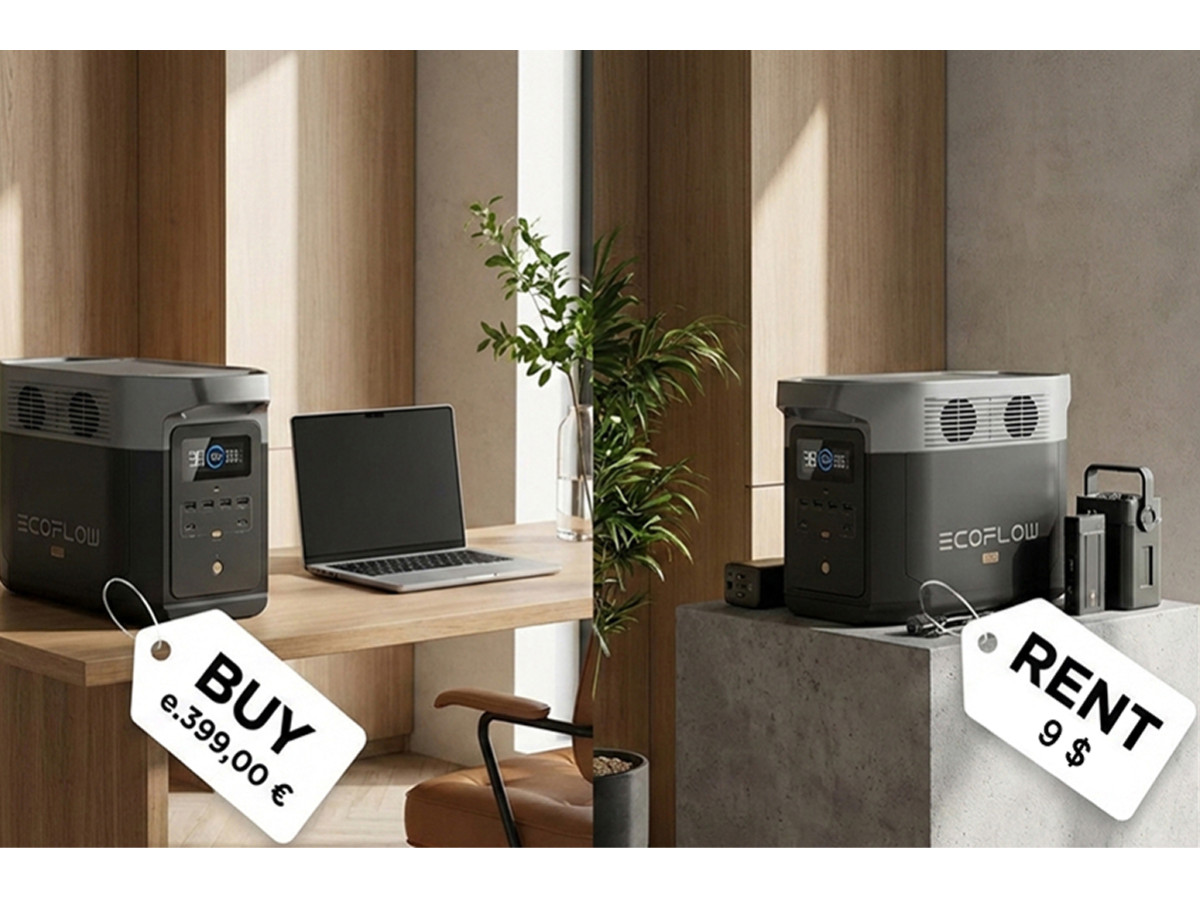
In recent years, demand for charging stations in Ukraine has been steadily growing. Unstable power supplies, scheduled and emergency outages, and increased demands for autonomy are forcing private users and businesses to increasingly seek backup power sources. Charging stations have become a versatile solution for homes, offices, retail, events, and outdoor work, providing power for appliances, lighting, telecommunications equipment, and security systems.
Against this backdrop, more and more consumers are facing a practical question: which is more cost-effective—buying or renting a charging station? Equipment cost, service life, frequency of use, and the current economic situation directly influence the choice. For some users, purchasing a charging station and using it permanently makes sense, while for others, renting a charging station is a more flexible and cost-effective solution.
That's why comparing buying and renting charging stations is especially relevant today. Understanding the real advantages and limitations of each option allows you to avoid unnecessary expenses, choose the optimal equipment layout, and ensure a stable power supply in today's uncertain energy environment.
Charging stationA charging station is an autonomous power source designed to store and then supply electricity to various devices and equipment. Unlike traditional generators, modern charging stations operate silently, emit no exhaust gases, and can be used both indoors and outdoors. This is why portable charging stations and stationary models have become a popular solution during power outages.
The primary purpose of a charging station is to provide backup or autonomous power. Depending on the model, the equipment performs the following functions:
Thanks to a wide range of outputs (220 V, USB, Type-C, 12 V), the charging station for home and business can simultaneously connect multiple devices - from smartphones and laptops to refrigerators, routers and cash register equipment.
The scope of application of charging stations is constantly expanding:
It's worth noting the popularity of renting charging stations for events, construction projects, and temporary projects when purchasing equipment is not economically feasible.
Based on format and purpose, charging stations are divided into several main types:
The choice of charging station type directly impacts the decision to purchase or rent equipment, making proper assessment of the tasks especially important at the planning stage.
Purchasing a charging station— is a solution designed for long-term equipment use and complete independence from rental services. This option is most often considered by users who need a charging station on a regular basis—for home, business, or commercial purposes.
For a clear comparison, the main pros and cons of the purchase are presented in the table below.
Thus, purchasing a charging station is justified in situations where the equipment is used regularly and for long periods. However, with occasional use or temporary tasks, the financial burden may be unjustifiably high, making leasing a more attractive alternative.
Renting a charging station has become one of the most popular ways to use off-grid power sources in recent years. Given the unstable power supply and constant changes in the equipment market, renting a charging station allows you to quickly acquire the right model without major capital investments, which is especially important for both private and business customers.
For ease of comparison, the main advantages and disadvantages of renting are presented in the table.
From a practical standpoint, renting a charging station is the optimal solution for temporary tasks, events, emergency outages, or testing equipment before purchase. However, for continuous use and long-term use, alternative options should be considered.
In today's reality, economic instability, rising electronics prices, and constant fluctuations in demand directly influence consumer decisions: whether to buy a charging station or rent one.
In recent seasons, prices for charging stations in Ukraine have fluctuated significantly due to demand and external factors. Market analysis shows that:
These price and demand fluctuations make a large one-time investment in purchasing a charging station riskier, as the buyer bears all market fluctuations, while leasing allows these risks to be mitigated.
In the current climate, many users prefer to rent charging stations rather than purchase them:
This format fits the current market situation, where charging equipment prices are subject to fluctuations and many consumers are unwilling to make large investments upfront.
Despite the above trends, purchasing a charging station can still be an economically viable choice in a number of cases:
Conclusion: In the current Ukrainian market conditions, leasing a charging station is often a more flexible and cost-effective solution, especially for short- and medium-term needs. However, with long-term use and a confident forecast of needs, purchasing can be a profitable strategy for those prepared for a one-time investment with a long-term view.
Renting a charging station is rational in cases where equipment is needed temporarily, without a permanent load or capital investment.
It is optimal if a charging station is needed:
Fact:When used for up to 2-3 weeks, renting is 5-10 times cheaper than buying.
Suitable for:
Advantage:You can choose a station exactly according to the required capacity and duration, without freezing the purchase price of 30,000–60,000 UAH.
Relevant for:
Practice:Renting allows you to borrow equipment only for the duration of the work and change its capacity to suit a specific task, without incurring maintenance and storage costs.
Purchasing a charging station makes economic and technical sense in situations where the equipment is used constantly and under heavy load. Below are clear criteria that make purchasing a better option than renting.
The purchase is advisable if the charging station is used daily or almost daily:
Number:With daily use, after just 2–4 months the total rental cost can exceed the purchase price of a mid-range station.
The purchase is justified for businesses where autonomous power supply is required on a permanent basis:
In such cases, owning a charging station reduces operational risks, eliminates dependence on the lessor's equipment, and allows for precise load calculations for specific business processes.
Purchasing is preferable if it is important:
Fact:When used as part of an autonomous power system (home, business), renting becomes pointless, as the equipment must be available continuously and without time restrictions.
Comparison of rent and pThe payback of the charging station shows thatthere is no universal solution— optimalThe correct choice depends on the objectives, timing and intensity of equipment operation.
Brief conclusions:
Why renting is often more rational today:
Thus, for most users, especially individuals and businesses with temporary loads, renting a charging station remains the most flexible and cost-effective solution in today's market conditions.